What the completed DZTR workflow demonstrates
The model is the dynamically zoned target release formulation of Yassin et al. (2019). The implementation adds explicit source preparation, parameter provenance, mixed-year calibration, reproducible searches and fixed-profile application. Etienne's archived implementation and study informed the weaker-data benchmarks. The mean-flow/donor fallback is an explicitly exploratory extension.
Data availability and predictive behavior
The controlled benchmark requested 32 monthly-target paper reservoirs. All 37 paper reservoirs remain in its inventory: Bull Lake retains a separate interval study; four source-gated cases have no admitted standard profile. Later source reviews and collection imports do not silently change this benchmark's membership or frozen parameters.
The main comparison uses the same 27 reservoirs with successful, scored trajectories across all four routes, and the same frozen held-out masks:
| Responses available for fitting | Median storage NSE | Median release NSE | Both NSE positive |
|---|---|---|---|
| Storage and release | 0.746 | 0.594 | 20/27 |
| Release only | -2.801 | 0.426 | 6/27 |
| Storage only | 0.431 | 0.176 | 11/27 |
| Neither | -2.082 | 0.334 | 4/27 |
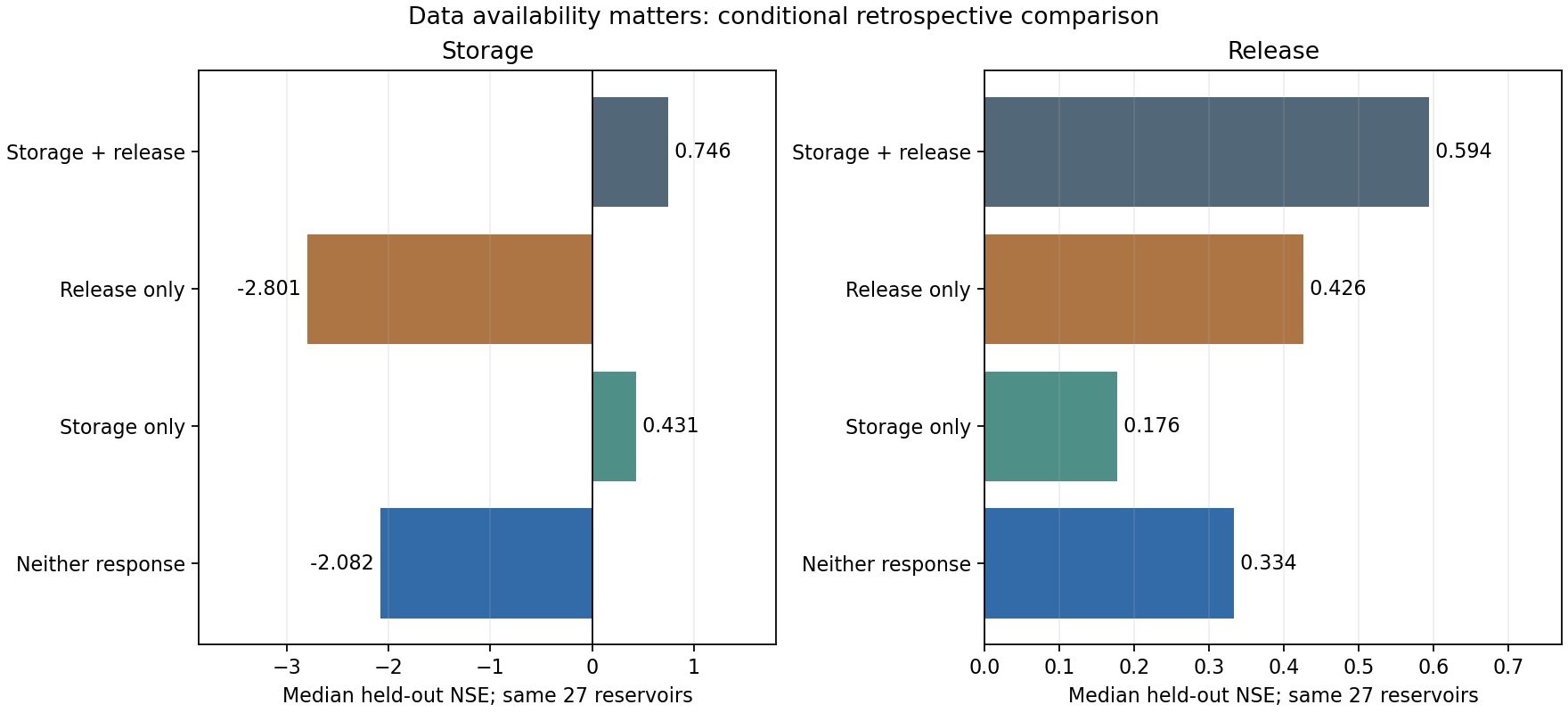
Storage observations matter for storage dynamics. Release-only fitting can produce useful release scores while storage remains poor. A positive release NSE alone does not establish plausible storage or a successful joint model. Storage-only fitting recovers more storage behavior but leaves release skill limited by its transferred prior. The no-response recipe is a functioning fallback with substantial storage limitations.
Completion and membership must remain visible. The available-case figures use each route's actual successful subset and must not be read as a matched ranking:
| Route | Completed / requested | Median storage NSE | Median release NSE |
|---|---|---|---|
| Observed storage and release | 32/32 | 0.717 | 0.638 |
| Release only, square-root-release objective | 27/32 | -2.801 | 0.426 |
| Storage only | 32/32 | 0.437 | 0.232 |
| Neither response | 31/32 | -1.056 | 0.334 |
The remaining release-only cases lack successful selected profiles at the saved checkpoint. The fixed no-response Tyuyamuyun simulation fails on 2001-04-01 with no feasible implicit root; the failure is preserved. A valid parameter table does not guarantee successful simulation at every timestep.
Machine-readable aggregate results and
reproduction receipt accompany
this curated report. tools/summarize_researcher_assessment_v1.py verifies the
cached source manifest and reproduces the medians, counts and figure without
new simulations or optimization. Observation series are not included here.
What was fitted and how much computation was used
| Route | Fitted information | Saved search checkpoint |
|---|---|---|
| Observed monthly | All 72 storage/release targets; joint calibration | NSGA-II, 512 evaluations per seed, three seeds |
| Flow only | Fixed capacity fractions; 36 release targets | DDS, 64 evaluations per seed of a frozen 512 horizon |
| Storage only | 36 storage targets; fixed release prior | DDS, 64 evaluations per seed of a frozen 512 horizon |
| Neither response | Fixed capacity fractions and mean-flow/donor release prior | Zero optimization evaluations |
Flow-only storage fractions are 0.20/0.30/0.97 of adopted capacity, with a declared active-storage adaptation in three cases. Storage-only and no-response release priors scale donor percentile-to-mean ratios by verified GRanD mean discharge where available, otherwise by a labelled calibration-inflow proxy. Annual prior targets repeat monthly; this does not recover a seasonal operating rule.
Different response access, initial states, target dimensions and search budgets mean this comparison does not isolate optimizer effects. The separate Gardiner full-data experiment compares DDS and GA with matched objectives, 72 fitted targets, bounds, seeds and 512 evaluations. It completed 12 searches and 6144 evaluations; it supports the optional implementations, not a universal optimizer ranking. Weighted storage/release priorities remain user inputs.
The workflow records evaluation budgets and persistent checkpoints. Consistent cross-experiment elapsed-time measurements are not available here, so no wall-time speedup is claimed. These checkpoints do not establish convergence.
Scientific safeguards and interpretation
- Targets and bounds are fitted on calibration observations only. At least 65% calibration support is retained, with wet/normal/dry whole years and continuous simulation state. Held-out results do not choose the seed, weights or route.
- The MATLAB port is checked against Trinity references. Numerical policies retain explicit multiple-root choices and no-root failures, conservative overflow and independent water-balance checks.
- Level-derived storage retains geometry, datum/reference, storage-definition, observation-clock and approximation qualifications. A gauge datum is not automatically a lake bed.
- Balance-derived forcing uses observed storage/release and is conditional on those responses. Algebraic closure cannot establish independent forcing or independent forecasting skill. The external donor records are regional.
- Source-gated reservoirs remain deferred. Exploratory profiles are labelled; source certification and global transferability remain unproven.
The three portable historical examples reproduce archived predictions and later-start model-state restarts exactly. These are application/reproducibility checks, separate from the frozen held-out performance assessment above.